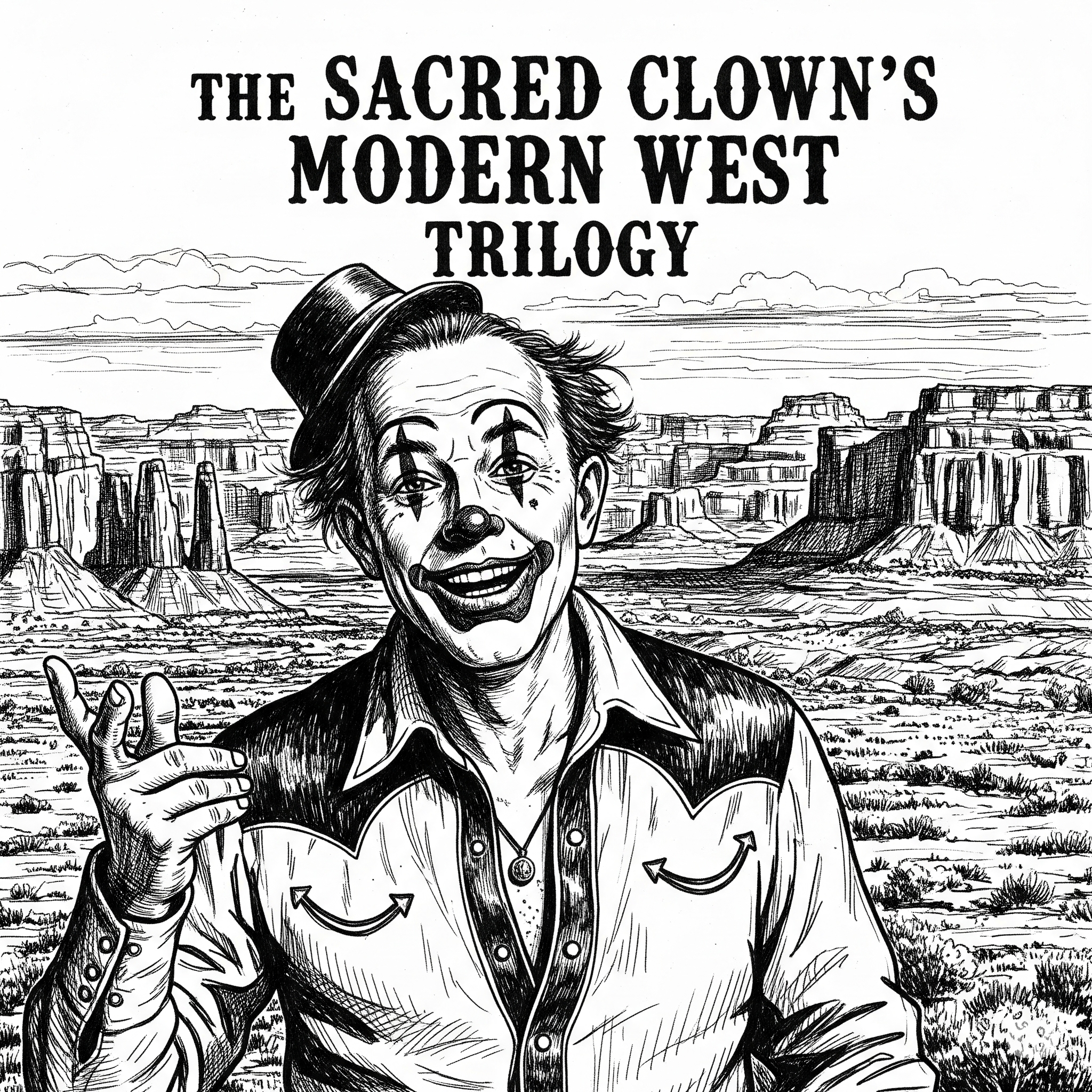
Bowing to his mournful pleas, the author somewhat grudgingly turned over the task of compiling a glossary to the Sacred Clown. This was sold to me on the premise that a lifeline was needed to keep the reader from drowning. It remains debatable that a lifeline is truly necessary for a handful of words that only sound foreign to an untrained ear? Perhaps not. But for some readers, the so‑called “New West” is literally foreign ground, especially where its first peoples are concerned.
The eternal rascal has also demanded license to sprinkle commentary throughout this glossary and, later, to tack epigraphs onto each chapter like warning labels on a toxic product. His efforts may prepare the reader for a deeper experience. They may also fall gloriously short. Either way, the Clown appears satiated. For now.
AIM (American Indian Movement). A group of Native activists, warriors, and troublemakers. If you see AIM in the rearview, you’re either in for a history lesson or a wild ride.
AAye (sometimes pronounced “AAA”). Is the word you’ll hear after someone in Indian Country tells a joke. It’s a lighthearted way of saying “I’m putting you on” or “Can you believe that?”
BIA (Bureau of Indian Affairs). A federal agency with a talent for paperwork and a knack for confusion. If you ever wondered how bureaucracy could be spiritual, you haven’t met the BIA.
Bubba. A name, a lifestyle, a state of mind. In Texas, everyone’s got a Bubba in the family, and if you don’t, check your birth certificate.
Budaghers. A real place, a family name, and a state of confusion. The Pecos Poet’s given surname. If you’re ever lost between Santa Fe and Albuquerque, you’ll see a failed outlet mall. That is today’s Budaghers. Yesterday’s Budaghers was a tribal trading post.
Cathedral Basilica of St. Francis of Assisi. The spiritual heart of Santa Fe, surrounded by iron grating and even thicker irony. Good for soul-searching and hiding from angry Texans.
Chaco Canyon. An ancient site in New Mexico with real heft. The original people there built giant houses with hundreds of rooms, lined them up with the sun and moon, and made roads stretching for hundreds of miles. Chaco was the spot for four centuries (850 and 1250 CE), where humans from the Americas came together to trade, celebrate, and swap tall tales. One of the Clown’s top twenty destinations for a spiritual cleanse.
Copenhagen. Not the city in Denmark, but the chewable, spitting tobacco that is badge of honor among low company. Known to cause oral cancer, and yellow, rotted teeth, villages and counties in the Dakotas couldn’t host annual spitting contests without it. Also known as snus.
Critical Thinking. A rare and endangered species that requires its alleged possessor to engage in deep thought at least every other third Tuesday. It is so infrequently demonstrated by god and mortal alike that conspiracy theorists insist in was invented by liberals and schoolteachers.
Dharma. A fancy word for “duty,” “path,” or “that thing you keep tripping over on your way to enlightenment.” In this novel it mostly means “excuse for bad decisions.”
Dharma Bum. A seeker, a wanderer, or someone who just can’t hold down a job. Jack Kerouac made it cool; your landlord or mortgage company doesn’t agree that you should live like that. The Pecos Poet wants very much to be the best possible Dharma Bum.
Ding Dong, Texas. A real town, with a fake-sounding name, and the perfect place to launch a fraudulent political career.
Elbowoods. A reservation town that exists no more except for submerged foundations of its original buildings, one of which still holds the 1942 Second Place State Basketball Tournament trophy.
Faux (or Fox) News. The oracle that glows on the walls of low-literate living rooms. If it’s not on Fox, it didn’t happen—or worse, it did and now you’re in trouble.
Fort Laramie Treaty. A mostly worthless piece of trope signed in 1851 and again in 1868, promising the Lakota, Dakota, and Nakota folks a whole lot of land and rights—right before the U.S. government promptly forgot what “treaty” means.
Garrison Dam. A giant concrete plug in the Missouri River, built so North Dakota could have more lakes, plentiful electricity, and fewer Native homelands. It flooded out the Mandan, Hidatsa, and Arikara, but hey, at least they now pay to fish for walleye where their ancestors used to spear them for free.
Ghost Dance. A 19th-century Native American religious movement that promised to bring back the ancestors, the buffalo, and a world without white folks. The U.S. government got so spooked they outlawed the dance—proving once again that nothing scares politicians like people having hope.
Hoka hey. Lakota for “let’s go!” or “let’s do it!”. Also used as a synonym for the more recent, “Skoden.” Uttering either term animates courage and determination in the face of adversity. Oglala Lakota leader Crazy Horse is said to have used it as a battle cry accompanied by sound eagle bone whistles at the Battle of Little Big Horn. If you know you lack conviction, stay away from this.
Honyockers. Also known as clods or clodhoppers. A pejorative word used to describe working-class farmers, cowboys, and miners who migrated to the Dakotas with no earthly idea that they’d soon be called colonizers.
Krumkake. A delicate Norwegian waffle cookie rolled into a cone shape. Like a crispy little snowflake you can eat—if you don’t mind your fingers getting sticky and touching off case of diabetes.
Lefse. A soft flatbread made from potatoes, flour, and butter. Think of it as the Scandinavian tortilla, perfect for wrapping up lutefisk or your regrets about eating lutefisk.
Little Ones. Psychedelic mushrooms and friends to humans seeking to peer through the cosmic veil. Only courageous mortals stick both feet on the other side of that zipper and the Little Ones are said to keep those feet on the Other Side.
Lutefisk. Cod soaked in lye until it’s basically a gelatinous fishy jelly. It’s the litmus test to determine whether a Scandinavian has courage and/or family loyalty. Smells reminiscent of a chemistry experiment gone wrong, and almost identical to the stench of a vat of uncovered pickles.
MAGA (Make America Great Again). A throwback American political movement regressive in nature and in this novel chiefly aligned with Odin. Throw in unrepentant Nazis and Russian oligarchs to round out the picture.
Mandan, Hidatsa, and Arikara Nation (or the Three Affiliated Tribes). The original landlords of the upper Missouri River, now mostly found on the Fort Berthold Reservation—when they’re not being flooded out or asked to sign another treaty.
Mazaska. The Lakota word for money. It’s derived from “máza” (metal) and “ská” (clear, white, pure), referring to the color of silver back when the federal government backed its money with real metal. Do not confuse mazaska with cryptocurrency.
Ómna. A Lakota word for “smells bad.” There’s much in this World, of course, that is pure ómna and oftentimes the pungency persists. Pronounced OH-MNAH and uttered with a sense of revulsion.
Patchouli Oil. The perfume of hippies, monks, and anyone trying to mask the smell of existential crisis. It was big in the 1960s but unsuitable now for life in the fast lane and almost impossible to find.
Pecan Pie. A staple of life concocted with dough, butter, and pecans, the Texas state nut. One exhibits her or his Lone Star bona fides by uttering “puh-KAHN pie” although pronouncing it as “pee-KAN,” as is done throughout the South, will also ensure safe passage in rural restaurants throughout Texas.
Peyote. A cactus, a sacrament, and a second cousin to the Little Ones. A shortcut to seeing the world as the Clown does—mischievous, beautiful, and more dangerous than can be described by mere words.
Rez Ball. Basketball as played on the rez. Fast, fearless, and with more ankle-breaking than the BIA’s annual budget. If you can’t run and gun or shoot from half-court, sit down.
Smultringer, sandkaker, and sirupsnipper are traditional Norwegian Christmas treats, lovingly prepared with lard. Some wayward Scandinavians have even hacked the calendar and started baking them in July—because nothing says ‘beach body’ like a hot wad of pig fat in a cookie.
Santa Fe Plaza. The beating heart of the City Different. Where locals, poets, and Texans collide in a daily pageant of commerce, art, and mutual suspicion. If you’re not selling something or being sold to, you’re probably lost. It’s a magnet for the covetous..
Sitting Bull’s Mutual Funds. A legendary but non-existent investment opportunity, mostly mythical, rumored to outperform Wall Street and any tribal casino—at least in this novel.
Skoden. A widespread Native word that translates to “let’s go then,” a derivation of the Lakota, “hoka hey.”
Spiritual Cretins. The Clown’s term of endearment for those who mistake bumper stickers and pasting regime propaganda memes on Facebook for enlightenment.
Standing Rock. Straddling the two Dakotas, it is a place, a movement, and proof that water is life—unless you’re an oil company, in which case water is a real problem.
TIT (Truth in Texas). A doomed government initiative to raise literacy and lower bullshit. Not to be confused with anything remotely successful. In this novel, the opposition to TIT’s is commonly known Texans Agin’ TITs (or TATs), proof that even lowly acronyms can provoke class warfare. In this novel, it’s TITs for TATs.
Texas Tourist. Easy to spot by their spankn’ new boots, waiving money around , and their inability to pronounce “Santa Fe” without a twang. They are a lamentably easy target for the poet’s acerbic wit. Texan tourists fall predictably into one or more categories of the seven deadly sins, a fact the Pecos Poet uses in his poetry.
Toka. The Lakota word for enemy. Try sneaking this in your next conversation with a member of Congress, if you ever see them out and about.
Tókša akhé. A Lakota phrase meaning “Later” or “See you later.” There is no Lakota word for “goodbye” since Lakota believe that connections are never permanently broken. Pronounced TOHK-shah ah-KHAY.
Tribal Council. The rez version of Congress, but with more drama and better food at meetings. It also provides a wide stage for acerbic wit.
Truth. A slippery, shape-shifting substance. It is often replaced with “what feels right at the moment.”
Turquoise. The official stone of Santa Fe. If you leave town without buying some, you’re doing it wrong. Some believe the highway south of town is paved with turquoise. They’re wrong.